

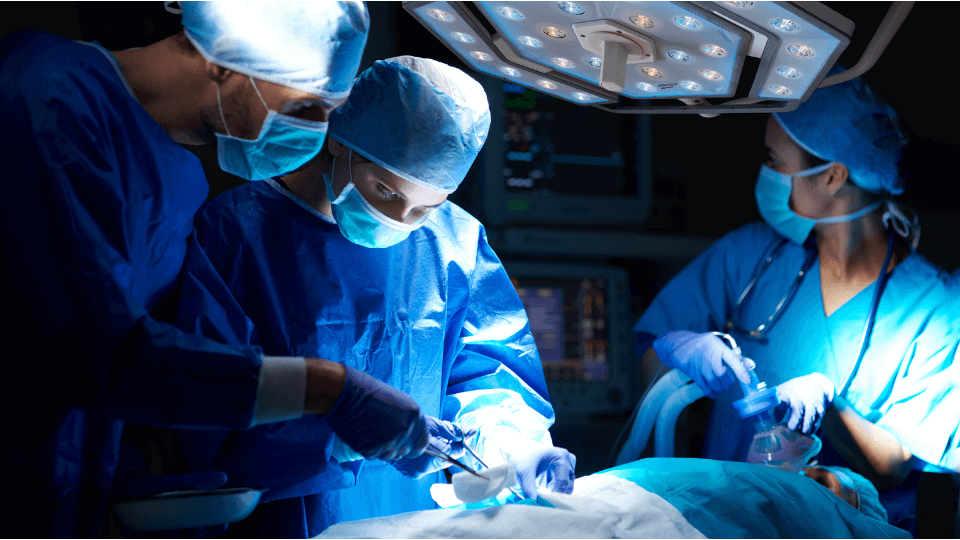
The two opposing goals
Shadowless illumination means the light field stays even and bright, even when the surgeon or instruments block part of the beam. To make that possible, light must come from multiple angles. Broad, overlapping beams cancel each other’s shadows. The result is a comfortable, low-contrast field that keeps surgeons from experiencing eye fatigue.
Deep-cavity illumination, on the other hand, is the exact opposite. It requires a concentrated, high-intensity beam that can reach far into confined surgical cavities without scattering or fading. This is held in high regard, because it is essential for working with small incisions, that result in minimal pain and damage to the patient.
There is a clear tension is for manufacturers: spread the light wide to erase shadows, and you lose penetration. Focus it tightly to reach depth, and you create shadows. Finding balance between these behaviors is at the heart of every surgical-light design.
Where standards bring clarity
The international standard IEC 60601-2-41 defines this problem in measurable terms. It recognizes that no light can be truly shadow-free. Instead, it sets a realistic benchmark for performance.
According to the standard, a surgical luminaire can be called shadowless when, even with two surgeons’ heads placed between the light source and the field, the illuminance at the bottom of a simulated surgical cavity remains at least 50 percent of the surface value.
This does two important things:
- It acknowledges the real surgical environment with movement, obstruction and depth.
- It gives designers and clinicians a shared framework to evaluate how well a light performs under real conditions.
There standards offer the guideline for innovation.
Recognizing the trade-off between shadowless uniformity and deep-cavity reach helps everyone involved: engineers, surgeons, biomedical teams and procurement officers. They all speak the same language. Surgeons can ask more informed questions about light quality and visibility. Engineers can optimize geometry and optics instead of chasing brightness alone. Procurement and marketing teams can benchmark performance using measurable data.
Understanding this paradox transforms the conversation from “how bright is it?” to “how well does it illuminate what matters?”
Beyond compliance
While the IEC standard defines the minimum expectation, excellence often lies beyond the threshold. EPMD’s flagship OT-light platforms meet the 50 percent retention the standard requires and they maintain over 99 percent of surface illuminance even at the base of the surgical cavity. It’s a quiet statement of design maturity. Surgical proof that when you truly understand a paradox, you can engineer harmony within it. The perfect OT light is all about balanced over brightness. It lives in that delicate middle ground between diffusion and focus. Between eliminating shadows and revealing depth. Recognizing the paradox is the first step to respecting, and ultimately mastering, the science of surgical illumination.
Keep in mind that your OT-lighting must offer way more than brightness. The OT is not a building site.